How Much Does The NFL Draft Combine Matter For Fantasy Football? A Deep Dive Into The Historical Data
Dwain McFarland goes test by test to break down just how important the NFL Draft Combine is for predicting future fantasy football success from the prospects.
The NFL calendar never stops, and the next big event is the NFL Draft Combine. With that in mind, we are going to dive into the data to determine how much each test matters for running backs, wide receivers and tight ends. In addition to athletic testing, we will assess height, weight and age.
First, we will look at how each data point correlates with future fantasy points per game in Years 1 through 3. At the same time, we will evaluate how the data correlates with NFL Draft capital, so we can compare and contrast what NFL executives consider most important with what has the strongest signal for fantasy football.
Second, we will look at the top fantasy performers as a cohort. While this limits our sample, it also provides additional insight into how much each NFL Combine attribute mattered for fantasy difference-makers.
Finally, we will summarize the thematic findings and examine an overall rank for all NFL Combine data points across RB, WR and TE.
If you want all the details, we have them here; if you just want the TLDR version, each section includes key takeaways and charts. And be sure to review the summary, which includes overall NFL Combine attribute ranks at the end.
Methodology Notes:
- We have built a robust dataset covering WRs and TEs drafted from 2018 to 2025. For RBs, it is slightly larger: 2017-2025. If a player didn't participate in the NFL Combine, Pro Day results were used when available.
- It's also important to note that we are correlating to point per reception (PPR) fantasy points per game (PPG) over the first three seasons of a player's career. For players with only one or two NFL seasons, the average is calculated from the available data.
- For NFL Draft Capital, we assign a value to every pick using Chase Stuart's adaptation of the Jimmy Johnson trade chart. Historically, the golden standard for draft capital in the fantasy community has been draft pick, but the value of a draft pick isn't linear. The fall-off from pick 1 to pick 15 is much larger than from pick 100 to pick 115. This adjustment accounts for the larger drop-off in the first round and a flattening as the draft progresses.
How important is age for NFL Draft prospects?
While age isn't something exclusive to the NFL Draft Combine, it is the time of year when this data becomes widely available for draft prospects.
Of all the NFL Combine data points, age ranks No. 1 for all three positions in correlation to future fantasy production. However, its signal is significantly stronger at the TE and WR positions than at RB. The correlations are negative because they indicate that being younger is a good thing. The lower the age, the higher the correlation with future fantasy production.
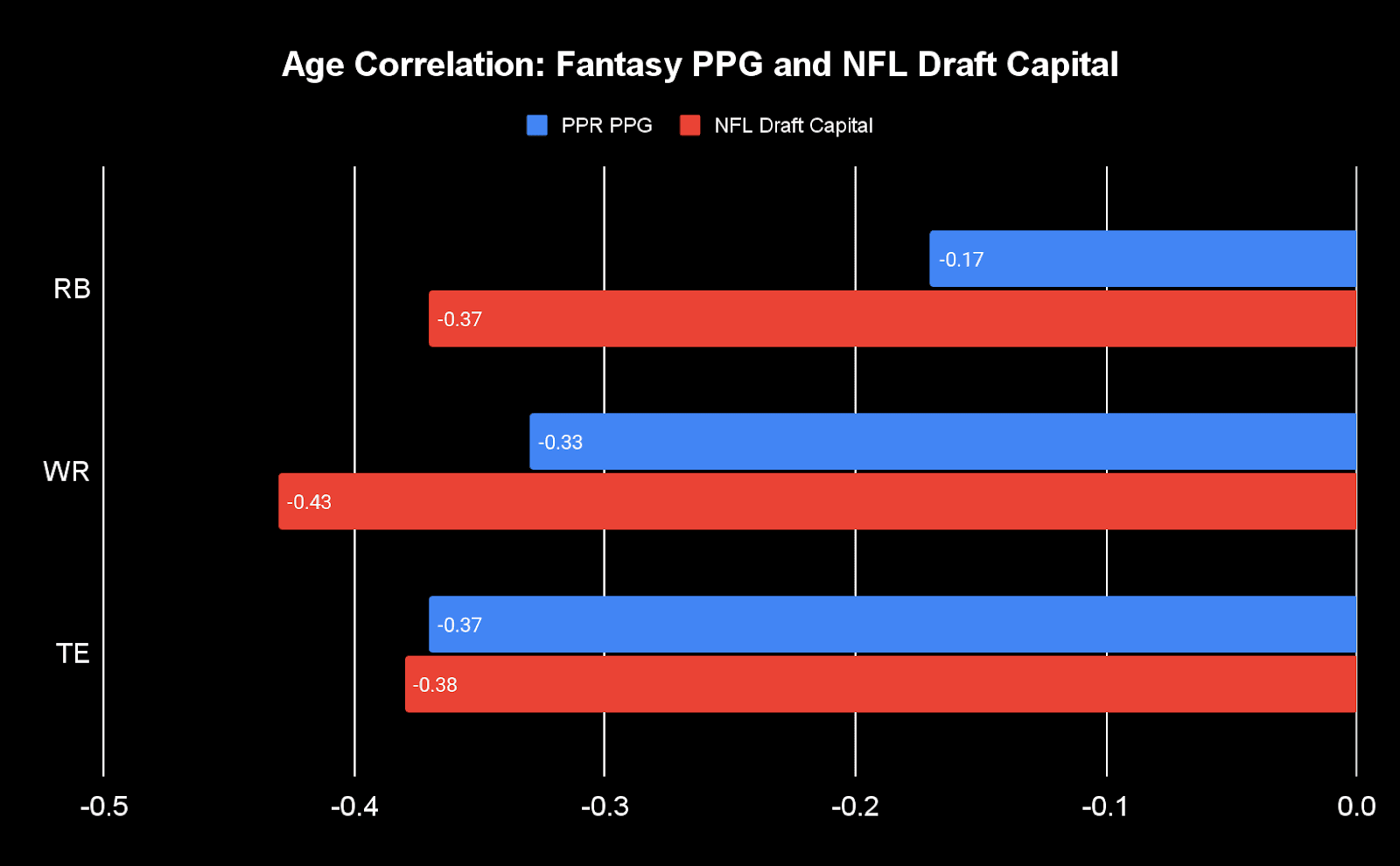
The NFL also places significant value on prospect age, which makes sense. Many blue-chip prospects declare for the NFL Draft after three seasons of college football.
Here are some recent examples of players who were 21 in their rookie NFL season:
- RB: Saquon Barkley, Christian McCaffrey, Bijan Robinson, Jahmyr Gibbs
- WR: Ja'Marr Chase, Malik Nabers, Drake London, CeeDee Lamb
- TE: Brock Bowers, Kyle Pitts, Colston Loveland, Harold Fannin Jr.
Production at ages 18-21 shows a stronger signal than at older ages. In fact, production at older ages correlates more highly with busts than hits in fantasy football.
It is interesting that, at RB, this dataset suggests the NFL may slightly overrate age. After all, fantasy managers want the same thing as NFL GMs: players who can pile up yards and touchdowns, preferably in a variety of ways.
For RBs, some of the distance between fantasy and NFL Draft capital signal could be driven by this caveat: poor depth charts and injuries can lead to near-automatic production at RB. While the level of success may vary by skill, it will still be enough to create a signal. So, in this example, circumstances that opened the door for older prospects to accumulate handoffs and checkdown passes (the two least-contested ways to earn an opportunity) could be a driver of the delta.
At the WR and TE positions, we don't see this nearly as often since getting on the field is just step one toward earning a target. There are exceptions, like a low-average depth of target (aDOT) slot WR or TE options, who compile gimme targets underneath the defense. It is important to keep this in mind when examining the remaining data points.
Now that we have a macro view of age, let's dive into the difference-maker cohorts. The thresholds for the cohorts are based on the average PPR PPG over the last three years.
- Top-24 RBs: 12.5 PPG
- Top-24 WRs: 13.2 PPG
- Top-12 TEs: 10.2 PPG (We will use 10 to slightly extend small samples)
RB difference-maker (12.5+ PPG) age analysis:
- 2017 to 2025 NFL Draft classes
- 29 prospects
- 79% were 22.6 or younger to start their rookie season
- 89% were 22.8 or younger
- Outliers: Najee Harris (23.5), Rhamondre Stevenson (23.5), Cam Skattebo (23.6)
Takeaway: We prefer RB prospects who will be younger than 23 as rookies.
WR difference-maker (13.2+ PPG) age analysis:
- 2018 to 2025 NFL Draft classes
- 20 prospects
- 65% were 22 or younger to start their rookie season
- All of the top eight performers were 22 or younger
- Outlier: Terry McLaurin (24, 47th percentile)
Takeaway: We prefer WRs who will be 22 or younger when the NFL season starts, but 23-year-olds with strong draft capital are in play.
TE difference-maker (10+ PPG) age analysis:
- 2018 to 2025 NFL Draft classes
- Seven prospects
- 86% were 22.8 or younger to start their rookie season
- Harold Fannin Jr. (21.1, 96th percentile)
- Colston Loveland (21.4, 91st)
- Brock Bowers (21.7, 85th)
- Mark Andrews (22, 80th)
- Sam LaPorta (22.6, 68th)
- Trey McBride (22.8, 66th)
- Outlier: Tyler Warren (23.3, 57th percentile)
It's worth noting that tuning into age provided an edge versus draft capital for Mark Andrews and Harold Fannin Jr. Their respective draft capital value percentiles were 30th and 24th, respectively.
Takeaway: We prefer TEs who will be younger than 23 when their rookie campaign begins.
2026 NFL Combine invitees who will be 21 in Week 1 (based on availability of date of birth):
- RB: Jeremiyah Love
- WR: Carnell Tate
- TE: Kenyon Sadiq
Players who will be 22.5 years or younger when their rookie seasons begin:
- RB: Desmond Reid, CJ Donaldson, Adam Randall
- WR: Makai Lemon, Jordyn Tyson, KC Concepcion, Ted Hurst, Chris Bell, Antonio Williams, Reggie Virgil, Ja'Kobi Lane, Zavion Thomas
- TE: Sam Roush, RJ Maryland, Jaren Kanak, Justin Joly
40-yard dash: How important is it for NFL Draft Combine prospects in fantasy football?
The 40-yard dash is the No. 2 NFL Combine factor when correlating to future fantasy production for RBs and TEs, while it ranks third for WRs. NFL GMs love pure, unadulterated speed. It ranks second among RBs and WRs and first among TEs when correlated with NFL Draft capital.
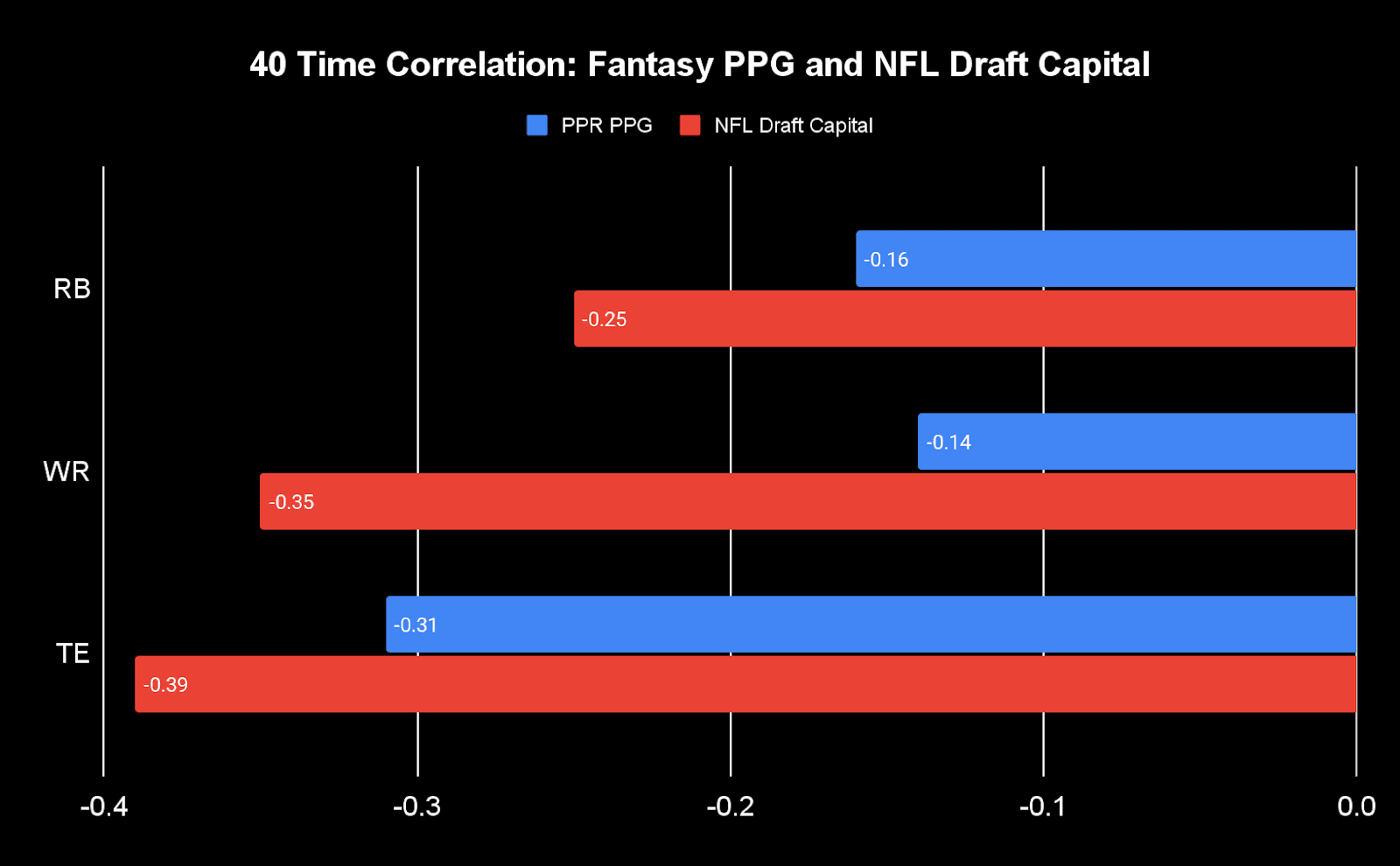
Interestingly, players' production over their first three seasons (AKA fantasy PPG) suggests that while 40 time is a top-three combine factor, it might be overrated at the WR and RB positions. The correlation delta of -0.21 between PPG and NFL Draft Capital at WR represents a 150% delta.
This all tracks. Some players win specifically with speed, but those who are limited to pure linear speed aren't locks for fantasy success. For RBs, power, vision, balance, elusiveness and so many other factors come into play.
If the NFL wants to overreact to speed in proportion, it has work to do at the TE position. It ranks first among the three positions in draft capital correlation (-0.39), but that represents only a 26% delta versus fantasy PPG (-0.31) vs. the 150% delta for WRs. The 40-yard dash fantasy correlation for TE is twice as strong as for RB or WR.
Most tight ends operate underneath the coverage with a low average depth of target (aDOT). The average for an NFL TE with at least 250 routes over the last five years is 6.6. That means for the majority of TEs, there is an opportunity to add value after the catch. As defenses react to receptions underneath the coverage, speed is one way to unlock additional yards.
RB difference-maker (12.5+ PPG) 40-yard dash analysis:
- 27 of 29 prospects recorded a 40-yard dash time
- Average: 4.49 seconds
- 74% had a 50th percentile time of 4.55 or better
- 55% had a 60th percentile time of 4.51 or better
- 30% had a 75th percentile time of 4.42 or better
- Outliers: Kyren Williams (4.65), Rhamondre Stevenson (4.64), David Montgomery (4.63)
Straight-line speed matters, but it's more of a threshold thing, and of these 27 prospects, 16 were drafted in the first two rounds of the NFL Draft, meaning draft capital is already accounting for speed.
Takeaway: We prefer RBs who run a 4.55-second 40-yard dash or faster.
Note: We will add more context when we get to weight and incorporate Speed Score.
WR difference-maker (13.2+ PPG) 40-yard dash analysis:
- 19 of 20 prospects recorded a 40-yard dash time
- Average: 4.44 seconds
- 100% had a 50th-percentile time of 4.55 or better
- 80% had a 60th-percentile time of 4.52 or better
- 37% had a 75th-percentile time of 4.41 or better
This data helps us better get our arms around the 40-yard dash, suggesting that it isn't so much about having an elite time as about having a good-enough time. A perfect prospect would have blazing speed, along with all the other traits necessary to dominate. It can be a differentiator for really good football players. Not track stars dressing up like football players for Halloween (h/t Robert Mays and The Athletic Football Show for that fantastic line). For years, you have heard scouts say things like, "he won't time well, but he is football fast."
For reference → WRs drafted since 2018 to reach the 90th percentile in the 40-yard dash (4.29) seconds:
- Xavier Worthy (4.21 seconds)
- Henry Ruggs III (4.27)
- Anthony Schwartz (4.27)
- Rondale Moore (4.28)
- Tyquan Thornton (4.28)
- Matthew Golden (4.29)
Takeaway: We prefer WRs who run a 4.55-second 40-yard dash or faster for fantasy.
TE difference-maker (10+ PPG) 40-yard dash analysis:
- 4 of 7 prospects recorded a 40-yard dash time
- Average: 4.63 seconds
- 100% had a 50th-percentile time of 4.74 or better
- 75% had a 60th-percentile time of 4.68 or better
- 25% had a 75th-percentile time of 4.57 or better
For TEs, the sample is small. Still, similar to RBs and WRs, the 40-yard dash is more about meeting a threshold than posting an outlier high-end time. Prospects need to be good enough.
Takeaway: We prefer TEs who run a 4.74-second 40-yard dash or faster in fantasy.
Note: Be sure to read the breakdown on weight below to see how we can combine it with 40-time to gain additional insights with Speed Score.
Broad Jump: How important is it for NFL Draft Combine prospects?
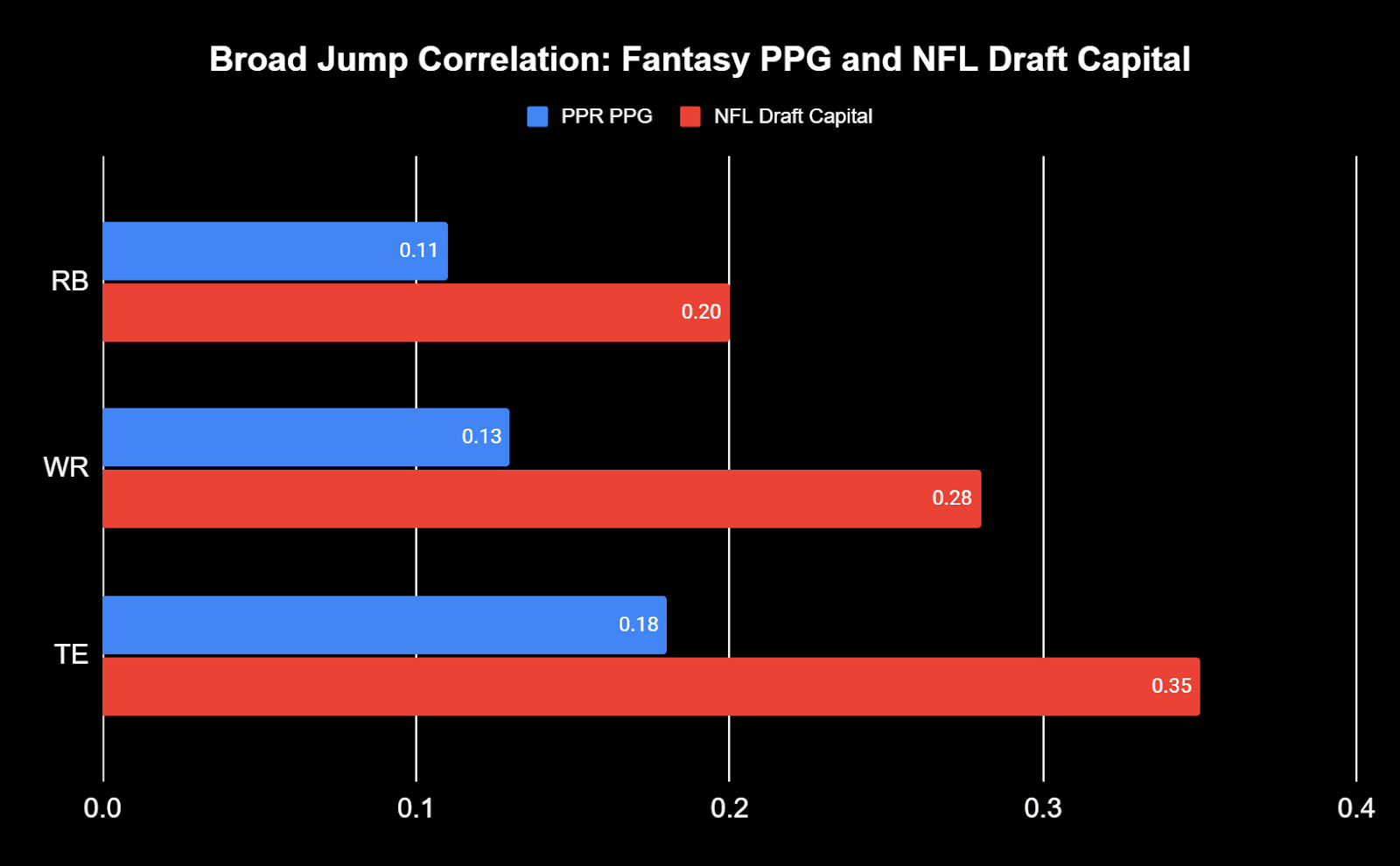
We observe a positive correlation rather than a negative one because a longer broad jump is theoretically better than a shorter one. When correlating to future fantasy success, the broad jump ranks third for RBs (tied with weight) and TEs and fourth for WRs.
From an NFL Draft capital correlation standpoint, the broad jump ranks third for WRs and TEs and fourth for RBs. For WRs, it's worth noting that the delta between correlation to vertical leap is negligible (0.28 vs. 0.27).
The broad jump belongs to the explosiveness group of tests, along with the 40-yard dash and the vertical leap. From a physics standpoint, it measures horizontal propulsion. In otherwords, the ability to accelerate from a standstill. This ties to explosive power and force production.
Nerd Note: Correlation between tests for each position. There is a significant correlation across the explosiveness tests, especially the vertical leap and broad jump.
RB correlation between 40-yard dash, vertical leap and broad jump:
- 40-yard dash to vertical leap: -0.29
- 40-yard dash to broad jump: -0.48
- Vertical leap to broad jump: 0.69
WR correlation between 40-yard dash, vertical leap and broad jump:
- 40-yard dash to vertical leap: -0.32
- 40-yard dash to broad jump: -0.35
- Vertical leap to broad jump: 0.70
TE correlation between 40-yard dash, vertical leap and broad jump:
- 40-yard dash to vertical leap: -0.41
- 40-yard dash to broad jump: -0.53
- Vertical leap to broad jump: 0.63
RB difference-maker (12.5+ PPG) broad jump dash analysis:
- 24 of 29 prospects recorded a broad jump
- Average: 122.1 inches
- 67% had a 40th-percentile jump of 122 or better
- 42% had a 50th-percentile jump of 123.5 or better
- 25% had a 60th-percentile jump of 126 or better
- 24% had a 35th-percentile jump of 119 or *worse*
At the macro level, the broad jump technically carries some signal, but it wasn't a differentiating factor for the difference-maker cohort. Alvin Kamara was the only player to be near the 75th percentile (74th at 131 inches). On the other hand, five players were around the 25th percentile:
- Dalvin Cook (116 inches, 26th percentile)
- Kyren Williams (116, 26th)
- Bucky Irving (115, 23rd)
- Josh Jacobs (112, 13th)
- Rhamondre Stevenson (112, 13th)
Takeaway: We prefer RBs with a broad jump of around 122 inches or higher, but it is not a deal breaker, and higher doesn't necessarily equate to better in fantasy football.
WR difference-maker (13.2+ PPG) broad jump analysis:
- 18 of 20 prospects recorded a broad jump
- Average: 124.7
- 72% had a 40th percentile jump of 121.5 or better
- 56% had a 50th percentile jump of 124.5 or better
- 20% had a 60th percentile jump of 127.5 or better
- Outliers: Calvin Ridley 110 inches (3rd percentile)
We don't see as many low-end outliers finding success at WR in our difference-maker cohort. However, high-end outliers don't differentiate the group either. It's about meeting the threshold of good enough (~121 inches or better).
Takeaway: We prefer WRs with a broad jump of 121 inches or higher, but being better isn't necessarily better for fantasy.
TE difference-maker (10+ PPG) broad jump analysis:
- 4 of 7 prospects recorded a broad jump
- Average: 117.8
- 75% had a 40th-percentile jump of 118.5 or better
Only one prospect, Sam LaPorta, in our small sample eclipsed the 50th percentile of 120 inches. While the broad jump carries a slightly stronger signal at the macro level across all prospects, it was more about being good enough (~118 inches or better) in our difference-maker cohort.
Takeaway: We prefer TEs with a broad jump of 118 inches or higher, but better testing doesn't correlate to better results in fantasy.
Vertical Leap: How important is it for NFL Draft Combine prospects for fantasy football?
Vertical leap ranks second on our list for WRs, fourth for TEs (tied with the short shuttle and three-cone drills) and fifth for RBs when correlating to future fantasy points.
As with the previous data points, NFL teams are accounting for this factor with draft capital. The vertical leap ranks fourth for WR and TE (tied with the shuttle). It ranks seventh for RBs, a tier below the three-cone and shuttle drills.
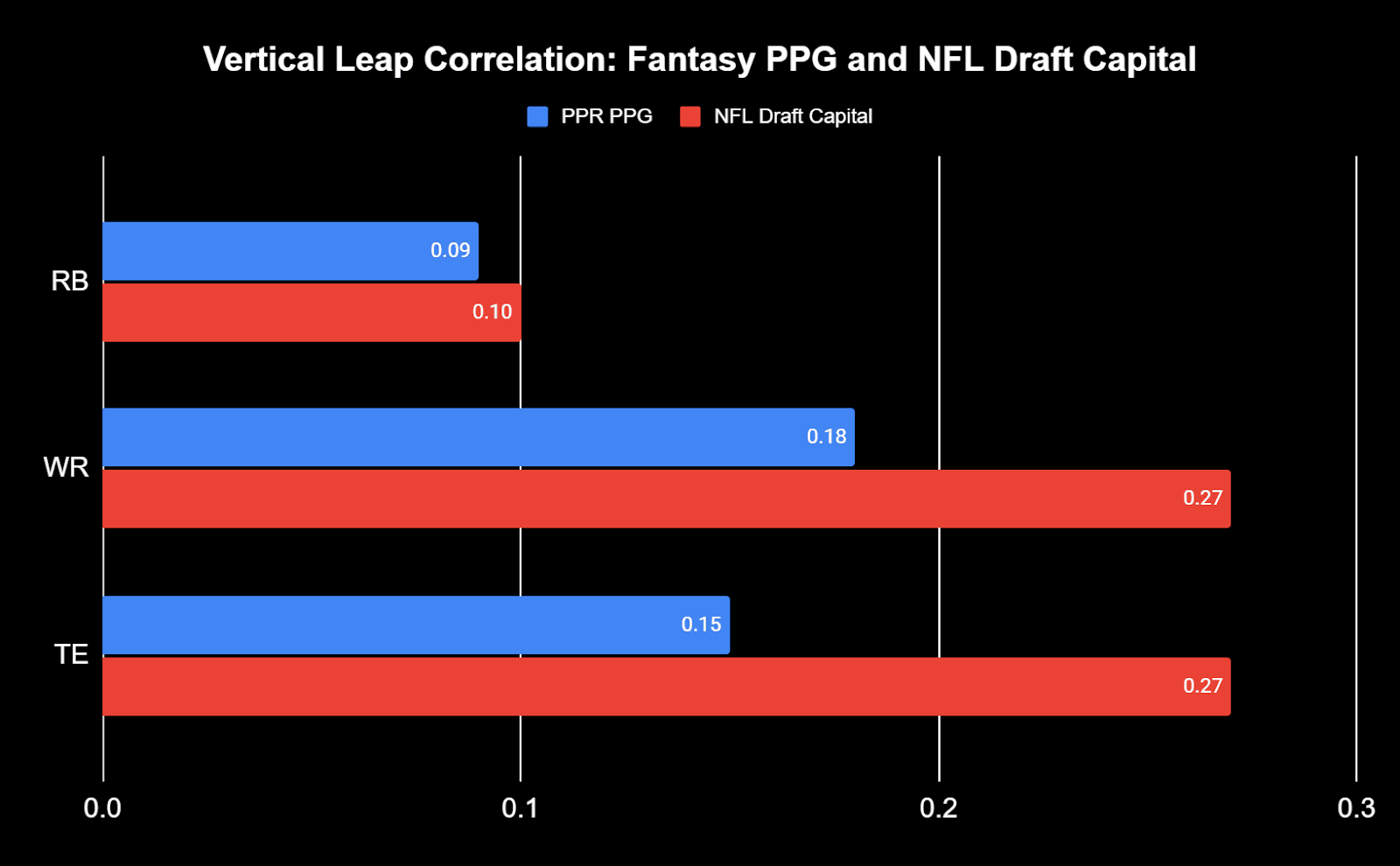
While vertical leap is considered a measure of explosiveness or burst, it's not surprising that it matters more for WRs and TEs, as it is an attribute that best applies to catching the football, especially in jump-ball situations. However, a high vertical doesn't guarantee that a player will perform well in those scenarios, as many other skills and refined techniques are involved.
Below are the top WR vertical leap performers who reached the 80th percentile or higher that we have data for since the 2018 draft class:
- Miles Boykin (43.5 inches)
- Rondale Moore (42.5)
- Malik Washington (42.5)
- Donovan Peoples-Jones (42.5)
- Jalen Coker (42.5)
- Daurice Fountain (42.5)
- Malik Nabers (42)
- Henry Ruggs III (42)
- Jalen Reagor (42)
- Ricky Pearsall (42)
- Jaylin Noel (41.5)
On a macro level, the vertical leap has a stronger correlation to fantasy success than the 40-yard dash for WRs. However, when slicing the data by the top 24 performers, it hasn't mattered as much.
WR difference-maker (13.2+ PPG) vertical leap analysis:
- 18 of 20 prospects recorded a vertical leap
- Average: 36.8 inches
- 67% had a 40th-percentile leap of 35.3 or better
- 50% had a 50th-percentile leap of 36.8 or better
Multiple high-end performers who were below the 40th percentile: CeeDee Lamb, Jaxon Smith-Njigba, Tee Higgins, Diontae Johnson and Puka Nacua. So, at the macro level, vertical leap carries a signal, but it wasn't a big differentiator within the difference-maker cohort. Different players win in different ways.
Takeaway: We prefer WRs with a vertical leap of ~35 inches or higher.
TE difference-maker (10+ PPG) vertical leap analysis:
- 4 of 7 prospects recorded a vertical leap
- Average: 33.3 inches
- 75% had a 40th-percentile leap of 32.5 or better
Once again, the emerging trend of being good enough shines through. None of our difference-maker cohort prospects had an outlier high vertical leap. However, we prefer players at or above the 74th percentile.
- Sam LaPorta (35 inches, 55th percentile)
- Harold Fannin Jr. (34, 48th)
- Trey McBride (33, 41st)
- Mark Andrews (31, 28th)
Key takeaway: We prefer TEs with a vertical leap of 32 inches or higher.
Shuttle Drill: How much does it matter for NFL Draft Combine prospects in fantasy football?
In the short shuttle, a prospect must move 20 yards with three lateral direction changes at five, 10 and five yards. It tests how an athlete moves to their left and right. Ultimately, the shuttle helps teams measure a prospect's lateral agility and quickness. A prospect who excels at the 40-yard dash might struggle or stand out in the short shuttle, so it offers a different lens.
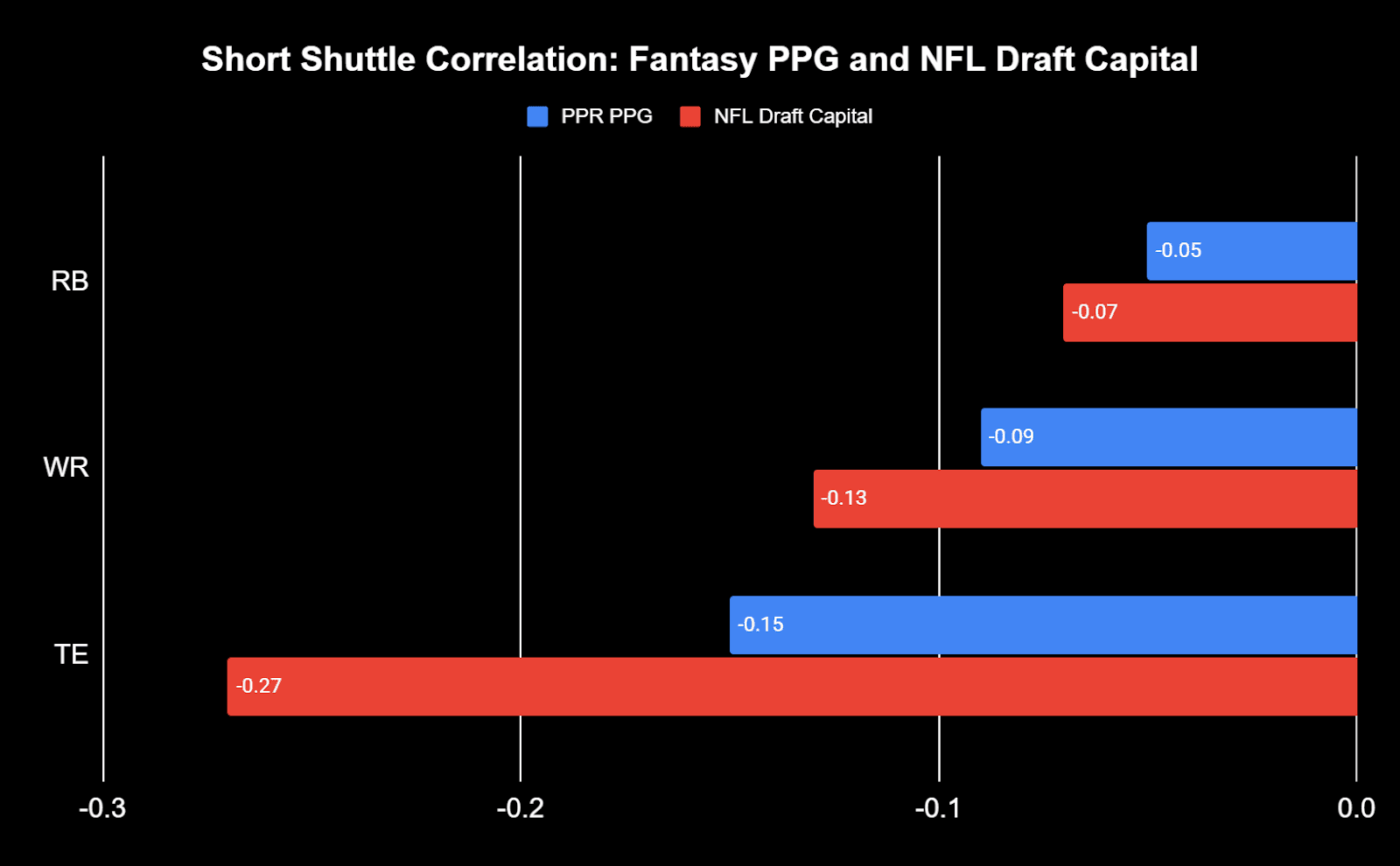
Overall, you will notice a significant drop-off in correlation to future fantasy points for RBs and WRs. However, at the TE position, the shuttle is just slightly below the broad jump and tied with the vertical leap.
The shuttle has a stronger correlation with draft capital at each position, but TE is the position on which NFL executives place significantly more value. The short shuttle correlation with NFL Draft capital at TE is twice that of WR and more than three times that of RB.
Nerd Note: Now is a great time to note the correlation between other drills and the short shuttle and three-cone tests. Interestingly, we observe varying results when comparing the 40-yard dash with the short shuttle and three-cone tests by position. Varying levels of participation could be a driver. However, we consistently observe the highest correlation between the short shuttle and the three-cone drills across all three positions.
RB correlation between 40-yard dash, short shuttle and three-cone drill:
- 40-yard dash to short shuttle: 0.10
- 40-yard dash to three-cone: 0.22
- Short shuttle to three-cone: 0.60
WR correlation between 40-yard dash, short shuttle and three-cone drill:
- 40-yard dash to short shuttle: 0.17
- 40-yard dash to three-cone: 0.12
- Short shuttle to three-cone: 0.66
TE correlation between 40-yard dash, short shuttle and three-cone drill:
- 40-yard dash to short shuttle: 0.37
- 40-yard dash to three-cone: 0.40
- Short shuttle to three-cone: 0.57
RB difference-maker (12.5+ PPG) short shuttle analysis:
- 14 of 20 prospects recorded a short shuttle
- Average: 4.26 seconds
- 79% had a 60th-percentile short shuttle of 4.27 or better
- 93% had a 40th-percentile short shuttle of 4.41 or better
- Outlier: Dalvin Cook (4.53, 24th percentile)
While the macro signal for RBs with the short shuttle suggests a lower correlation than many other tests, at the difference-maker cohort level, it mattered more. The thresholds matter more than an outlier high-end performance, but most backs checked the 60th percentile or better box. Below the 40th percentile represents the danger zone.
Key takeaway: We prefer RBs with a short shuttle time of 4.27 seconds or faster, but 4.41 is good enough.
TE difference-maker (10+ PPG) short shuttle analysis:
- 3 of 7 prospects recorded a short shuttle
- Average: 4.34 seconds
- 100% had a 50th-percentile short shuttle of 4.41 or better
Key takeaway: We prefer TEs with a short shuttle of 4.41 seconds or faster.
Three-cone drill: Is it important for NFL Draft Combine prospects in fantasy football?
The three-cone drill, often referred to as the L-drill, measures a prospect's flexibility and ability to change direction quickly. The drill includes 90- and 180-degree turns. As mentioned above, it correlates strongly with the short shuttle.
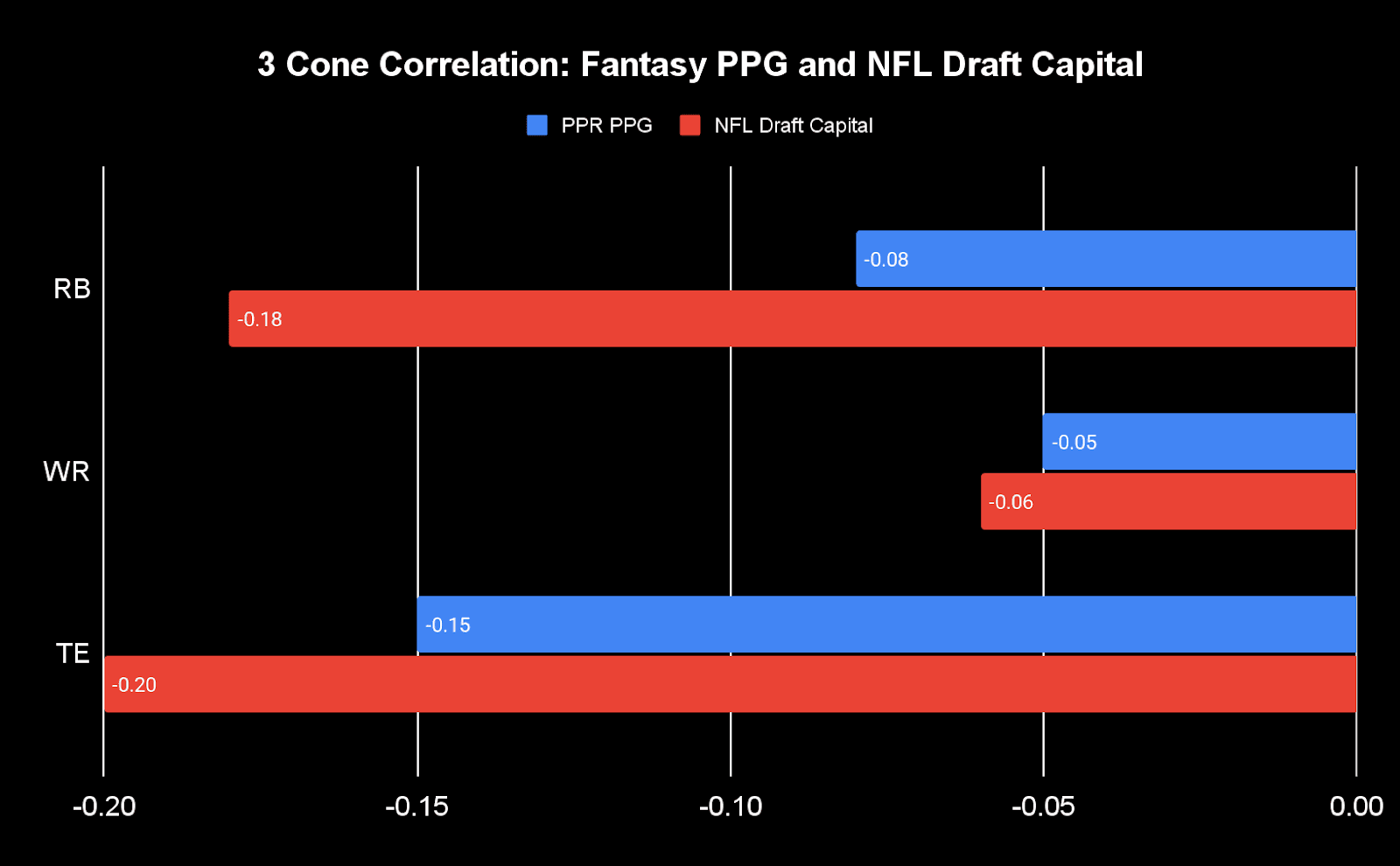
For RBs, the three-cone carries a stronger macro signal than the short shuttle, ranking sixth for future fantasy production. For WRs, the three-cone test carries slightly less signal than the short shuttle and ranks sixth. At the TE position, the three-cone drill ties with the shuttle and vertical drills when correlated with NFL production.
In a continuing trend, the NFL brass values each of these tests more than future production would suggest. While the difference at WR is negligible versus PPG, there is a significant gap when looking at RB and TE.
RB difference-maker (12.5+ PPG) three-cone analysis:
- 12 of 20 prospects recorded a three-cone time
- Average: 7.00 seconds
- 92% had a 40th-percentile three-cone of 7.16 or better
- 50% had a 50th-percentile three-cone of 7.06 or better
- 33% had a 60th-percentile three-cone of 6.96 or better
- Outlier: Dalvin Cook (7.27, 29th percentile)
Christian McCaffrey has the best three-cone time on record since the 2017 draft class at 6.57 seconds. While the results have been tremendous for him, the three-cone drill has been more about meeting thresholds. We prefer players at the 40th percentile or higher.
Key takeaway: We prefer RBs with a three-cone time of 7.16 seconds or faster, but there are diminishing returns for even better results.
WR difference-maker (13.2+ PPG) three-cone analysis:
- 11 of 20 prospects recorded a 3-cone time
- Average: 7.01 seconds
- 82% had a 50th-percentile three-cone of 7.10 or better
- 36% had a 60th-percentile three-cone of 6.99 or better
- 18% had a 30th-percentile three-cone of 7.32 or *worse* (DK Metcalf and Puka Nacua)
Jaxon Smith-Njigba holds the second-best three-cone time since 2018 at 6.57 seconds. Of course, JSN has become a superstar, but within our cohort, reaching the 7.10-second threshold was the key.
Key takeaway: We prefer WRs with three-cone times of 7.10 or faster, but faster times don't guarantee greater NFL production.
TE difference-maker (8.5+ PPG) three-cone analysis:
Yes, I reduced the points threshold from 10 to 8.5 here. There were only three prospects with a three-cone time recorded in the 10+ PPG cohort.
- 7 of 14 prospects recorded a three-cone time
- Average: 7.04
- 86% had a 40th percentile three-cone of 7.13 or better
- 57% had a 50th percentile three-cone of 7.01 or better
- Outlier: Mark Andrews (7.34, 18th percentile)
Key takeaway: We prefer TEs with three-cone times of 7.13 or faster.
How much does weight matter for NFL Draft prospects?
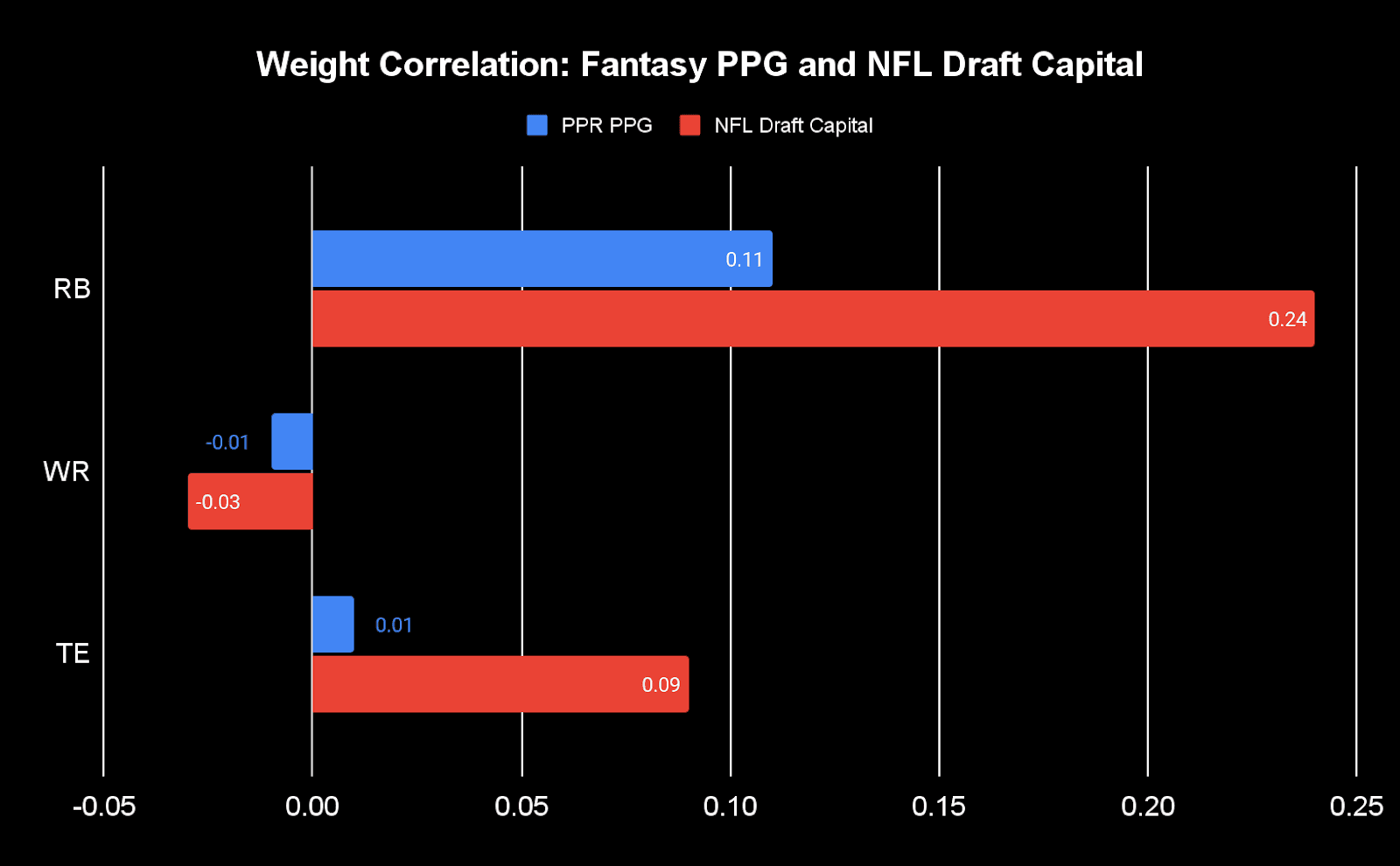
Running back is the position where weight matters the most for future fantasy production, tied for third with the broad jump. It also ranks third in correlation with NFL Draft capital.
For WRs, the correlation between weight and future NFL production (PPG) and draft capital is low.
For the TE position, weight ties for the least important aspect when predicting future production, whereas the correlation with draft capital is higher, but also still ties for last at the position in rank.
RB difference-maker (12.5+ PPG) weight analysis:
- 29 of 29 prospects recorded a weight
- Average: 216 pounds
- 86% weighed 200 or more pounds
- 72% weighed 210 or more pounds
- 14% weighed 199 to 188 pounds
- 0% weighed less than 188 pounds
Jahmyr Gibbs, De'Von Achane, Kyren Williams and Bucky Irving were the four backs who weighed in under 200 pounds and made the difference-maker cohort. Those are amazing fantasy players, so we don't want to rule out prospects that weigh less than 200 pounds. It is just a rarer occurrence.
There is only one RB in the 2026 draft class who weighs less than 185 pounds who received an NFL Combine invite (based on pre-combine data): Desmond Reid at 162 pounds.
Key takeaway: We prefer RBs who weigh 200-plus pounds, but ~190+ is acceptable when targeting outlier upside.
WR difference-maker (13.2+ PPG) weight analysis:
- 20 of 20 prospects recorded a weight
- Average: 199 pounds
- 55% weighed 200 pounds or more
- 70% weighed 195 pounds or more
- 25% weighed 180 to 190 pounds
- Outlier: DeVonta Smith (170 pounds, 19th percentile)
Calvin Ridley, Jaylen Waddle, Garrett Wilson and Diontae Johnson represent the 180 to 189 pounds group. While weight doesn't have a strong correlation with future success at the macro level, in this difference-maker cohort, it showed a greater signal, though there were still exceptions.
Key takeaway: We prefer WRs who weigh 195+ pounds, and the majority of exceptions (75%) below this threshold were Round 1 NFL Draft picks.
TE difference-maker (10+ PPG) weight analysis:
- 7 of 7 prospects recorded a weight
- Average: 248 pounds
- 100% weighed 240 pounds or more
- 71% weighed 245 pounds or more
At TE, for the most part, players are more closely clustered in weight, which is part of why we observe such a low correlation with fantasy points at the macro level.
Key takeaway: We prefer TEs who weigh 240+ pounds, but additional weight isn't necessarily a plus for fantasy purposes (receiving TEs).
Another intriguing application of weight is to contextualize 40-yard dash times. When we combine weight with 40-yard dash time, we get additional context. One way to do so is to use Bill Barnwell's Speed Score.
Here is the formula: (Weight * 200) / (40-yard dash time)4
For those unfamiliar with exponents (the 4 next to the 40-yard dash time above), this is another way of looking at the formula:
(Weight * 200) / (40-yard dash * 40-yard dash * 40-yard dash * 40-yard dash)
This formula does a couple of cool things. First, the exponent makes small differences in 40-yard dash times more meaningful. Second, it helps normalize the results so that the average prospect score is approximately 100.
Speed Score Correlations:
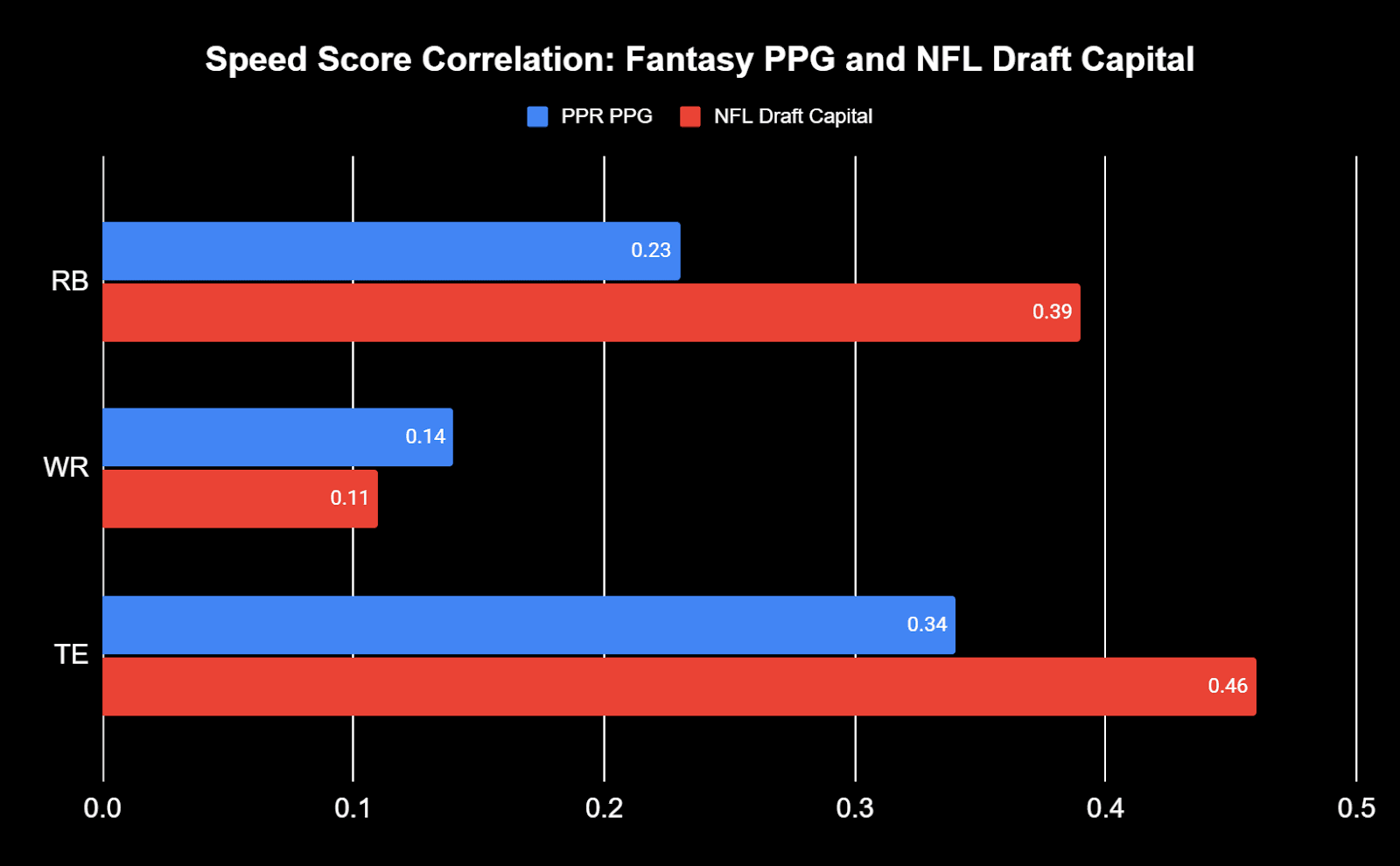
While we don't gain anything at the WR position, where Speed Score and the 40-yard dash have the same signal, it is significant for the other two positions. For RBs, Speed Score correlates more strongly to future success than any individual data point we have evaluated. For TEs, it correlates more strongly with future production than any other data point, except age.
Speed Score slightly edges out age for RBs when correlating to NFL Draft capital (0.39 vs. -0.37). At TE, it would move to No. 1 over age (0.46 vs. -0.38).
Does height matter for NFL Draft prospects in fantasy football?
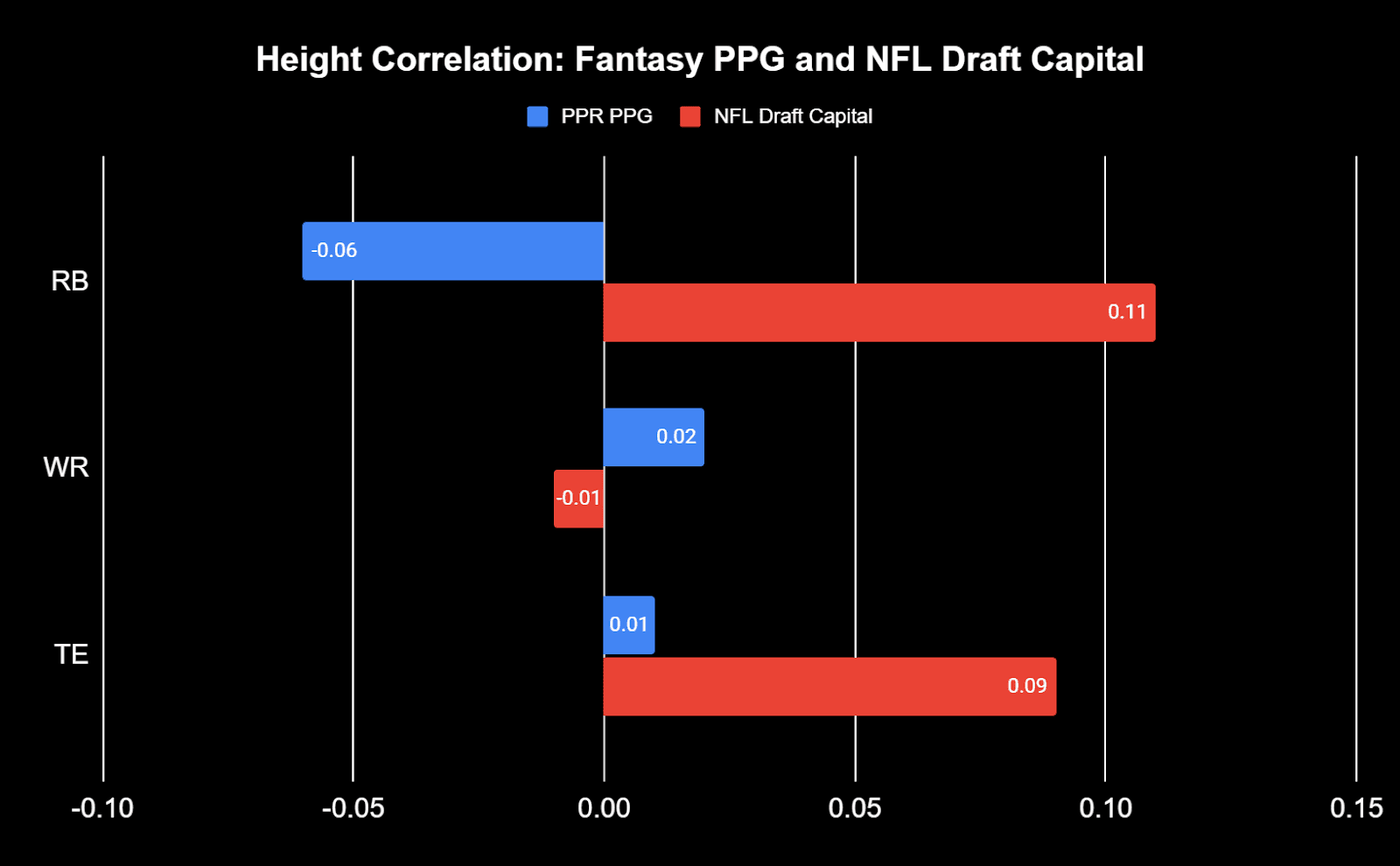
The correlations for height to future fantasy production are low across the board.
- RB: -0.06 (7th out of eight NFL Combine attributes excluding Speed Score)
- WR: 0.02 (7th)
- TE: 0.01 (tied with weight for last)
From an NFL Draft capital correlation perspective, it ranks sixth for RB, eighth for WR and ties for last with weight at TE.
RB difference-maker (12.5+ PPG) height analysis:
- 29 of 29 prospects recorded a height
- Average: 70.4 inches
- 100% had a height of 68.5 inches (5',8.5") or taller
- 62% had a height of 70 (5'10") inches or taller
Key takeaway: We prefer RBs who are 68.5 inches or taller, but taller doesn't mean better.
WR difference-maker (13.2+ PPG) height analysis:
- 20 of 20 prospects recorded a height
- Average: 72.6 inches
- 80% had a height of 72 inches (6'0") or taller
- 45% had a height of 74 inches (6'2") or taller
- Outliers: Jaylen Waddle (69.5, 23rd percentile), Zay Flowers (69, 18th percentile)
Key takeaway: We prefer WRs that are 72 inches or taller, but taller doesn't necessarily equate to better future fantasy production. Outliers on the shorter end of the spectrum have been Round 1 draft picks.
TE difference-maker (10+ PPG) height analysis:
- 7 of 7 prospects recorded a height
- Average: 76.2 inches
- 100% had a height of 75 inches (6'3") or taller
Similar to weight, heights are closely clustered for the majority of TE prospects. Brock Bowers, Sam LaPorta and Harold Fannin Jr. were all 75 inches, and Trey McBride was 75.6.
Key takeaway: We prefer TEs that are 75 inches or taller, but taller doesn't necessarily mean better for fantasy purposes.
Ranking NFL Combine attributes across RB, WR and TE
To wrap up all the findings, let's take a look at the attributes we discussed in order of rank based on correlation to future fantasy production. But before we do that, let's quickly recap some of the bigger themes from our research:
- The NFL places more emphasis on combine testing than future production would suggest. Correlations with draft capital are stronger than those with PPG in almost 100% of cases.
- NFL Draft capital is capturing the signal for these drills, even though some tests might be overvalued versus a fantasy lens.
- NFL Draft capital is the best predictor of future fantasy success. Given that the NFL Combine is impacting draft capital, that is the No. 1 reason it matters. Teams are also gathering additional interview and medical data, which we aren't always privy to.
- Being good enough in combine drills is more important than being outlier good. Thresholds are higher for some categories than others in difference-maker cohorts.
- Most bad outliers are typically accompanied by strong draft capital.
- Age and the 40-yard dash carry the most signal at the macro and cohort levels.
- Many of the individual drill correlations are low by themselves and are overall not very meaningful for fantasy. But thresholds can still help provide guidelines.
- Some drills with a low overall correlation to fantasy points pick up signal in the difference-making cohorts. Weight and height are good examples. The short shuttle for RBs is another good example.
- Combining weight with 40-yard dash times with Speed Score helps us contextualize the two data points in a way that is meaningful for RBs and TEs.
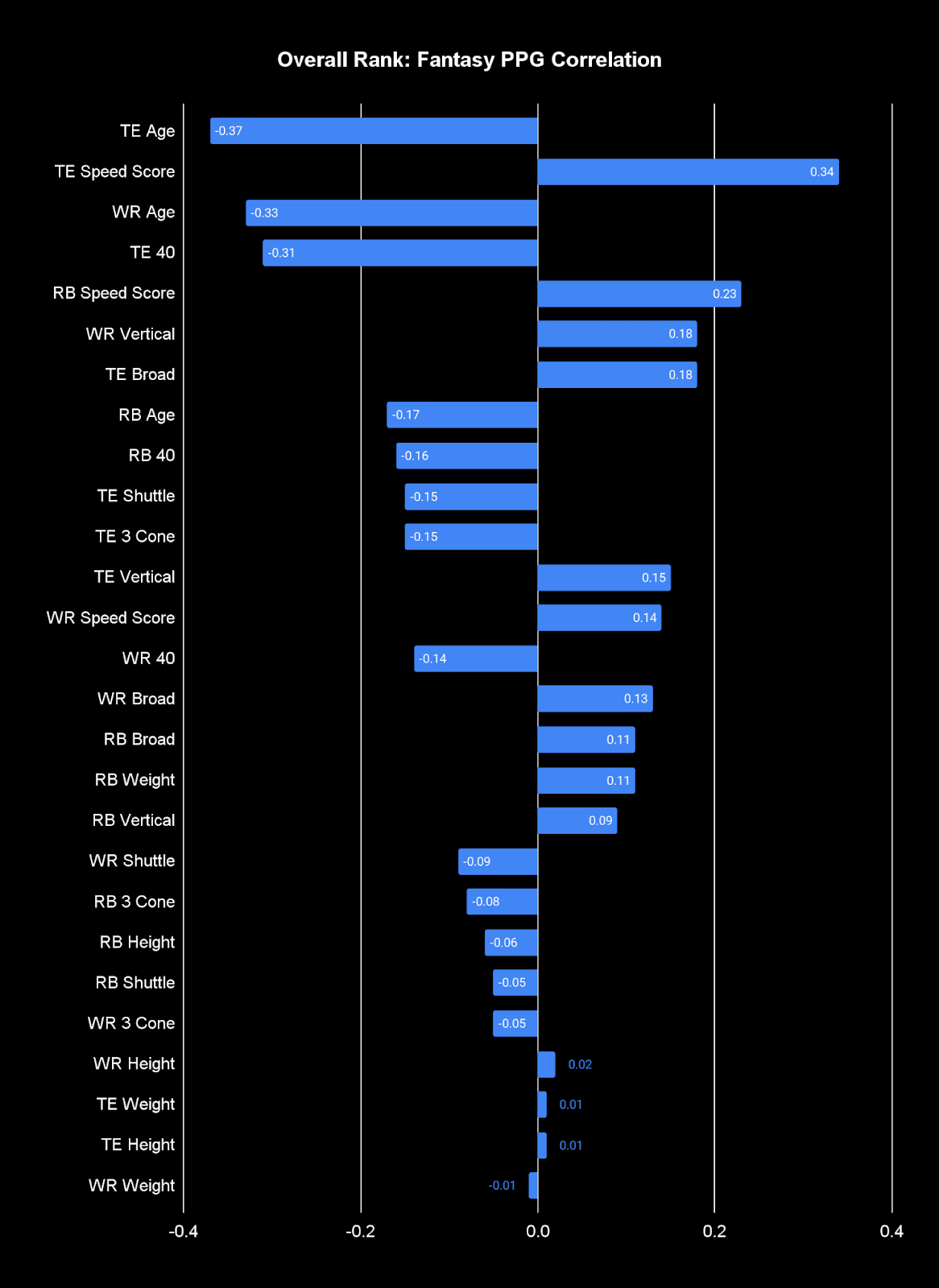
For the overall rankings, I have added Speed Score to the list. Remember, attributes where lower numbers correlate more to fantasy, there will be a negative correlation. Attributes where higher results correlate more with fantasy will have a positive number. They are ordered by level of impact, so positives and negatives can be next to each other.
Key takeaways:
- Age, Speed Score and the 40-yard dash are the most important—they make up seven of the top nine attributes. Age and Speed Score are tied to every attribute with a correlation of 0.20 or higher.
- The NFL Combine matters the most for TE. There are three attributes with a correlation of 0.31 or better and seven drills with a correlation of at least 0.15. TE accounts for seven of the top 12 spots.
- The NFL Combine matters equally for WR and RB. WR has two data points in the top ten versus three for RBs. However, WR age is the third-most important overall.
- The broad jump and vertical leap are close in terms of macro signals after age, Speed Score and the 40-yard dash. However, the signal is significantly weaker, and being good enough rather than great in these categories is more important. (see key takeaways from those sections).

Join Our Newsletter
Trusted by 400,000+ fantasy football players. Get access to Fantasy Life's free award winning newsletter and tools, all in one step.
By registering or logging in, you agree to our Terms of Use and Privacy Policy.