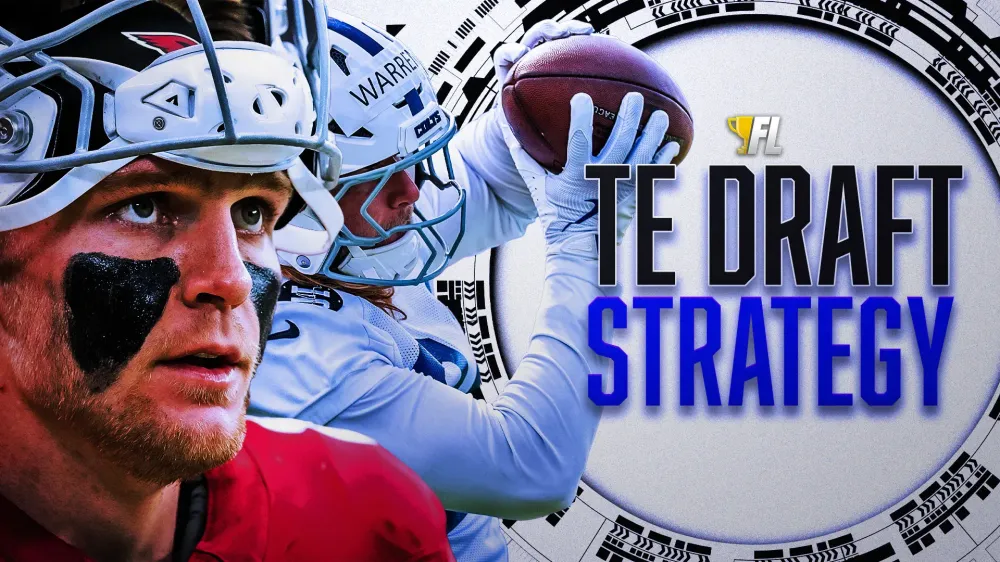
Tight End Draft Strategy for Fantasy Football 2025: Trey McBride, Sam LaPorta, and More TE Pillars
When building your fantasy draft strategy, start by asking these three key questions:
- Positional Supply and Demand: How many players do I need, and how many are available? Scoring and roster settings can significantly impact this.
- Value: Are there mispriced players I can target later? If so, I can wait on the position and build around these value picks.
- Draft Capital Allocation: How much have I already spent at the position? Early investments typically mean fewer picks spent later, and vice versa.
Using these principles and our rankings hub (customized to your scoring and roster), you can build a flexible strategy. Each season, ADP helps us identify which positions to prioritize early and where to find value.
We've already nailed down the QB draft strategy—now it’s time to dive into the 2025 TE landscape. Don’t forget to check out the TE Tiers article for supporting research.
To access all our tools (such as my projections and our Fantasy Life ADP Draft Board), use the promo code "DWAIN" for a 20% discount on the FantasyLife+ package.

Tight End Supply and Demand
Starting lineup requirements
Most fantasy leagues only require one starting TE, which places less demand on the position.
Talent: The limiting supply factor
Unlike RBs, who can produce simply by getting carries, TEs must check several skill-based boxes before scoring fantasy points: beat coverage, get open on time, catch the ball, and add value after the catch.
Playing time matters, but targets drive production, and targets are talent-driven. While the demand is lower, only a few have the skills to become true difference-makers.
The good news: an exciting youth wave (Brock Bowers, Trey McBride, Sam LaPorta, Colston Loveland, Tyler Warren) combined with quality veteran values gives us some flexibility at the position in 2025 drafts.
Tight End Values: Strategy Pillars
Below is an outline of TEs priced too low in different ranges of fantasy drafts.
Rounds 1 to 4
I love Brock Bowers, but he’s not listed here because he isn’t undervalued. He can be a strategic pillar, but the opportunity cost is steep. On most platforms, you’ll need to pass on players with similar or greater scoring potential at higher-demand positions.
Examples by site:
- ESPN: Brian Thomas Jr., Drake London, Jonathan Taylor
- Sleeper/Yahoo: De'Von Achane, A.J. Brown, Drake London
I prefer all of them over Bowers—but if they’re gone and he slides, he’s a target.
Trey McBride | Cardinals
- Consensus ADP: 27 (Round 3)
- Age: 26 (Prime)
- Fantasy points per game (PPG): 15.0 (as starter), 15.6
There are two things I love about getting McBride in early Round 3 of drafts.
First, he is in the same tier as Bowers. They are identical archetypes: low aDOT (6.5), high target share (29%) players. McBride is an elite option in his prime.

Second, the opportunity cost equation is much more palatable. The WR and RB options hit a tier break before you get to McBride.
WR and RB options going in the same range as McBride:
- ESPN: Kyren Williams, Tyreek Hill
- Sleeper: Kyren Williams, Jaxon Smith-Njigba, Tyreek Hill
- Yahoo: Chase Brown, Tee Higgins, James Cook
While these are still potential high-quality players, they all come with some questions we don't have about the Round 2 picks that Bowers battles for a spot in your draft queue.
McBride is in the sweet spot where talent and opportunity costs make him a sensible Round 3 selection.
George Kittle | 49ers
- Consensus ADP: 37 (Round 3-4 turn)
- Age: 32 (Post-prime)
- Fantasy PPG: 13.5, 12.0, 15.8
Kittle ranked No. 1 in PPG (15.8) last season. Injuries to Brandon Aiyuk, Christian McCaffrey, and Deebo Samuel revealed the George Kittle we came to know from 2018 to 2020. In a condensed offense, he notched a 22% target share and posted a whopping 2.62 YPRR—that is elite WR1 territory, y'all.
With Samuel gone, Aiyuk recovering from an ACL injury, and an unproven Ricky Pearsall, Kittle is positioned for another strong season. The 32-year-old offers more vertical presence than Bowers and McBride, with 9.9 and 8.9 aDOTs the last two years. Historically, that has made a difference for TEs that broke fantasy football wide open.
Brock Purdy has averaged over 260 passing yards in back-to-back seasons, and Kyle Shanahan's scheme (64% motion, 39% two-WR sets) creates ideal opportunities for Kittle to produce.
With a Round 4 ADP and paths to volume and efficiency, Kittle is my favorite early-round TE in 2025 drafts.
Rounds 5 to 8
Sam LaPorta | Lions
- Consensus ADP: 57 (Round 5)
- Age: 25 (Prime)
- Fantasy PPG: 13.8, 11.3
LaPorta was the top tight end drafted in 2024 after a 13.8 PPG rookie season, but disappointed early with just 11.3 PPG. However, he played through injuries—a hamstring in camp and an ankle sprain in Week 3.
From Week 12 on, he returned to full strength, logging 87% route participation and averaging 14 PPG with an 86 Utilization Score across the final eight games, including playoffs.

Detroit’s offense remains crowded, Ben Johnson is gone, and Jared Goff could regress, but the Lions should still be one of the league’s better units. LaPorta will compete with Jameson Williams for the No. 2 role behind Amon-Ra St. Brown.
LaPorta is a strategy pillar, but I’ve drafted him sparingly due to target competition—still, his talent and contingency upside in a potent offense remain enticing.
Rounds 9+
This group blends proven veterans and upside youth. If you’ve waited on TE and have an elite QB, consider drafting two if value aligns.
Evan Engram | Broncos
- Consensus ADP: 97 (Round 8-9 turn)
- Age: 31 (Post prime)
- Fantasy PPG: 10.8, 13.7, 9.9
Despite dealing with injuries in 2024, Engram maintained a substantial 25% target share after posting 24% in 2023. He has been consistent against both man (25%, 23% TPRR) and zone coverage (24%, 28% TPRR), showcasing his reliability as a volume receiver.
While his 5.8 aDOT limits touchdown upside, he offers elite reception potential—grabbing 114 balls in 2023 and pacing for 89 in 2024. Now in Denver, Engram fits well in Sean Payton’s system with limited competition beyond Courtland Sutton and the RBs.
Engram projects for 104 targets and 79 receptions, operating as one of the top two options in a Broncos offense that could improve in Bo Nix's second season.
Engram is a high-floor TE option in PPR formats, offering volume security in Round 9–10 of fantasy drafts.
David Njoku | Browns
- Consensus ADP: 97 (Round 8-9 turn)
- Age: 29 (Prime)
- Fantasy PPG: 10.4, 13.0, 13.1
Njoku offers a similar profile to Evan Engram but plays in a murkier QB situation. Despite that, he’s delivered strong back-to-back seasons with 13.1 and 12.8 PPG. In six games with Joe Flacco in 2023, Njoku averaged 16.2 PPG, earning a 28% target share and 2.02 YPRR.
He’s a low-aDOT option with limited TD upside but can rack up underneath targets, making him valuable in PPR formats.
Njoku projects for 100+ targets and is a solid volume play in a shaky offense.
Tyler Warren | Colts
- Consensus ADP: 118 (Round 10)
- Age: 23 (Pre-prime)
Concerned about the Colts’ low passing volume and crowded depth chart? It’s fair, but talent can change everything. Just like many overlooked Brock Bowers due to his situation, don’t sleep on Warren. He may not be Bowers, but talent creates opportunity.
The Colts have rotated tight ends, but none were the No. 14 overall pick. Warren should earn a full-time role quickly. He’s a yards-after-catch machine who fits perfectly in Shane Steichen’s RPO-heavy system. Over the past two years, the Colts rank No. 1 in RPO rate (22%) and No. 4 in play action (28%), an excellent match for Warren’s skill set. Expect Indy to scheme him into space often.
Warren’s underlying upside and fit make him a prime breakout candidate, regardless of target competition. He’s my most-drafted tight end through 65 drafts (21.5%), per the Best Ball Player Exposure tool.
Tucker Kraft | Packers
- Consensus ADP: 114 (Round 10)
- Age: 25 (Prime)
- Fantasy PPG: 9.6
Kraft wasn’t a target hog in 2024 (15% share), but he excelled after the catch with a 9.3-yard average. Many of his big plays came in long-down-and-distance situations, but the man is a playmaker. After Luke Musgrave's Week 4 injury, Kraft averaged 10.5 PPG.

With Matthew Golden added in Round 1 and Jayden Reed poised for a Year 3 leap, target competition could increase, but no Packer is an established alpha. Kraft is in the mix.
Matt LaFleur’s scheme (6th in motion, 10th in play action since 2022) can create easy looks underneath, where Kraft thrives.
Kraft is a borderline TE1 with upside.
Colston Loveland | Bears
- Consensus ADP: 122 (Round 11)
- Age: 21 (Pre-prime)
Loveland is the fifth-highest rated TE ever in the Rookie Super Model. His comps hit a top-12 TE finish 100% of the time by Year 3, with 33% reaching top-three status. He’s a versatile weapon who can attack all levels of the field and create mismatches.
Cole Kmet's presence could delay his breakout, but Loveland has the talent to erupt if he claims the starting role. The Bears' offense was a mess in 2024, but new OC Ben Johnson and an upgraded O-line offer hope.
He may start slow, but Loveland has top-six upside. He pairs well with Engram or Njoku.
Honorable Mentions:
Mark Andrews | Ravens: Andrews is slightly overpriced (83) considering the rotation danger with Isaiah Likely. Still, he offers the combination of target earning (22% targets per route) and downfield prowess (10.8) that can unlock massive upside. After battling injuries early in the season, Andrews averaged 13.1 PPG in 14 games from Week 6 onward. Andrews is a target when he falls past ADP.
Tight End Draft Capital & Strategy Guidelines
Knowing where the value pockets are for TEs in drafts, we can now set some guidelines for our draft strategy.
Round-by-Round Guidelines
- Rounds 1 to 4: Target Bowers if he falls to the end of Round 2; McBride in early-to-mid-Round 3; Kittle in Round 4
- Rounds 5 to 8: Target LaPorta or Andrews if they slide past ADP
- Rounds 9+: Don't draft another TE if you already have one; if not, target two of Njoku, Engram, Warren, and Loveland if you have a top-four dual-threat QB
Additional Notes
- Only roster one TE if you took one in the first five rounds
- In 2 RB, 2 WR, and 1 Flex leagues, I typically aim for an elite QB or TE in Rounds 3 and 4 this year. I don't want to be searching for both positions later. Drafting one of each can make filling out the rest of the RBs and WRs difficult, but it is an option depending on ADPs on your platform.
- In 2 RB, 3 WR, and 1 Flex leagues, I am more willing to wait on the onesie positions—the supply-and-demand equation changes with more starting WRs and RBs (two flex leagues). Still, I am willing to grab one elite from the QB/TE groups in Round 3 or 4.
General Strategy Tips
- Monitor how your draft is going compared to the ADPs on which your strategy was created. If your league mates use sources other than the rankings and draft queue for the site, they could draft very differently.
- Pay attention to your opponents' needs between your pick and your following selection. For example, if it is Round 9 and they all have a TE, then you can take a calculated risk to pass on the TE to take another position, knowing they shouldn't draft two. One caveat to this rule: if the players behind you don't know what they are doing or are new to fantasy, don't assume they won't take the TE—they just don't know better.
- Pay attention to the names at the top of the draft queue by position. If there is a player you want and their name is near the top of the list, don't be afraid to reach. When players are on the clock and unsure who to take, they often default to names at the top.