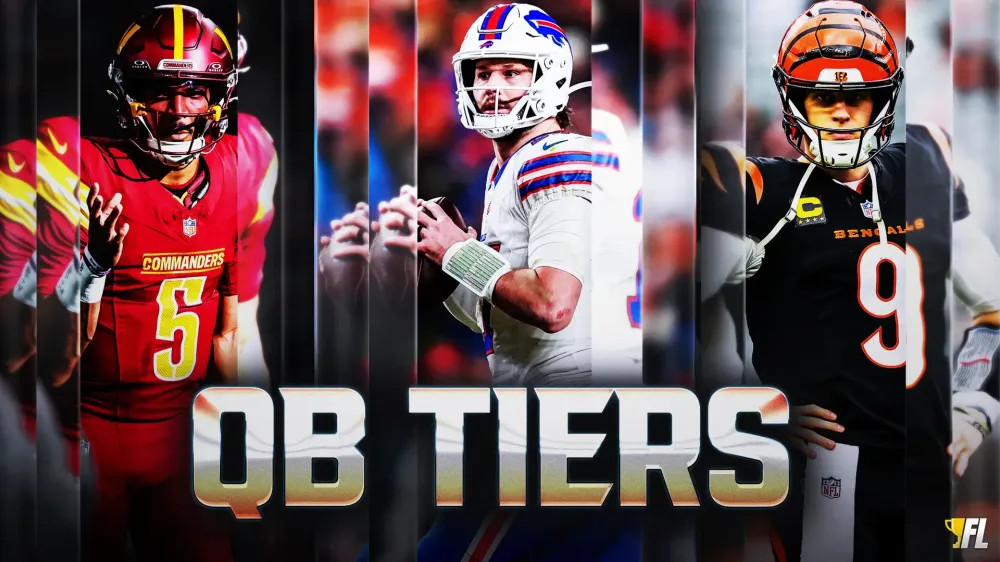
Way-Too-Early QB Tiers For Fantasy Football: Where Does Jayden Daniels Fall in 2026?
Matthew Freedman breaks down his way-too-early 2026 QB tiers for fantasy football, highlighting tiers worth avoiding and players outside of the top-12 that could be late-round targets.
We're still officially weeks away from the 2026 NFL year (Mar. 11), which kicks off with free agency, but the NFL scouting combine starts today (Feb. 23), the franchise tag window closes the day after the combine ends (Mar. 3), and then the legal tampering period begins shortly after that (Mar. 9).
All of which is to say that, even though we're in the offseason, there's no offseason: 2026 fantasy football is very much front of mind.
So, in this article, I want to run through my Fantasy Life QB rankings and highlight how I have them tiered. Specifically, I'll give notes on all the players in my top 12 and then note a few late-round QBs I like.
To access our 2026 fantasy football ranks, use the promo code FREEDMAN for 20% off the FantasyLife+ package.
2026 Fantasy Football Quarterback Tiers
Tier 1: Josh Allen
I think Josh Allen is in a tier unto himself. While there might be other QBs selected in his same general draft range, I feel much better about Allen than all the other options.
Allen has been a top-two fantasy QB in every season since 2020, and last year he was the No. 1 QB with 23.2 points per game. Even without longtime No. 1 WR Stefon Diggs, Allen has improved as a passer over the past two seasons (8.2 AY/A vs. 7.2 in first six years), and under OC Joe Brady, he has had 12+ TDs rushing in each of the past three campaigns. With Brady now elevated to HC, Allen's usage and productivity should remain intact.
If I'm going to pay up for a QB in 2026, it's Allen.
Tier 2: Drake Maye & Lamar Jackson
Drake Maye ultimately failed to win MVP in 2025, and his postseason performance underwhelmed (6.4 AY/A), but last year in the regular season, he finished No. 1 in AY/A (9.5) and composite EPA + CPOE (0.223, per RBs Don't Matter). With his willingness to attack downfield (9.3-yard aDOT) and abandon the pocket for easy rushing yards (10% scramble rate, per our Fantasy Life Utilization Report), Maye has an elevated fantasy ceiling and solid weekly floor. That said, he's also probably priced near his ceiling.
Lamar Jackson seemed ready for a change after an injury-hampered 2025, and that's what he got with the departures of former HC John Harbaugh and OC Todd Monken. But not all changes are good: Harbaugh championed Jackson early in his career, and Monken helped him become the NFL's most efficient passer over the past three years (9.4 AY/A). Coming off a career-low 26.8 rushing yards per game last season and paired with new and inexperienced OC Declan Doyle, the 29-year-old two-time MVP enters an uncertain era.
Maye and Jackson are great, but this is a tier of QB I'm fine avoiding.

Premium
Go FantasyLife+
Your league is unique. Your advice should be too. Get personalized tools, rankings, and projections tailored to your fantasy football league settings.
Tier 3: Joe Burrow, Jayden Daniels, Jalen Hurts & Jaxson Dart
Like the previous tier, this one doesn't appeal to me too much.
Of the four, I think Joe Burrow has the fewest questions, while Jaxson Dart might have the most upside.
Burrow missed half of last year, but in his six weeks after returning from injury, he averaged 270.0 yards passing, and in his full 2024 campaign, he had an NFL-high 4,918 yards and 43 TDs. Burrow has offered little as a runner over the past few years (9.4 yards per game), but he's still one of the league's best pocket passers, and he has one of the league's best receiving groups, led by WRs Ja'Marr Chase and Tee Higgins. Business as usual.
Jayden Daniels looked like the future of the league in his 2024 OROY-winning debut, but in 2025 he played just seven games because of multiple injuries, and his efficiency declined (6.9 AY/A vs. 7.6; 4.8 yards per carry vs. 6.0). He hopes to rebound in 2026, but No. 1 WR Terry McLaurin turns 31 years old in September, and OC David Blough has no play-calling experience and just two seasons as a coach. In abundance, Daniels has both upside and downside.
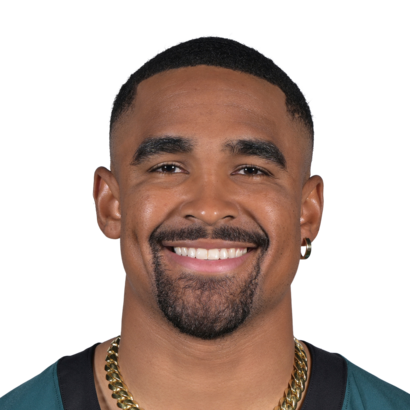
Jalen Hurts entered 2025 as reigning Super Bowl MVP, but then he underwhelmed as a passer (201.5 yards per game) and runner (career-worst 421 yards, eight TDs as a starter). Now he enters 2026 with his seventh playcaller in seven years, and OC Sean Mannion has no play-calling experience and just two years as a coach. Additionally, the "Tush Push" could be banned this offseason, and No. 1 WR A.J. Brown could be traded away. Eagles fly, but like all creatures, they also die.
Dart was a top-three fantasy QB last year with 23.1 points per game in seven rookie starts with HC Brian Daboll, thanks to his league-high 16% designed rush share. But after Daboll's dismissal and Dart's midseason concussion, the team curtailed his called rush attempts (7%). New OC Matt Nagy (as Bears HC) helped second-year QB Mitch Trubisky progress significantly in 2018. Maybe he can do the same for Dart now, but it's worrisome that his 2023-25 Chiefs offenses never ranked higher than No. 15 in scoring.
Tier 4: Justin Herbert, Trevor Lawrence, Caleb Williams
Adjusting for cost, I prefer this cohort to the previous one. All three of these QBs carry questions, but they also could achieve career-best campaigns.
Justin Herbert had a career-high 498 yards rushing last year, and this year his overall situation is better: Injured OTs Rashawn Slater and Joe Alt should return to health, new OC Mike McDaniel should be an upgrade over former playcaller Greg Roman, and Herbert's young supporting players (WRs Ladd McConkey and Quentin Johnston, TE Oronde Gadsden, RB Omarion Hampton) should continue to develop. With ball-control HC Jim Harbaugh, Herbert's unlikely to pass for 5,000 yards again, but 4,000 in the air and 500 on the ground are achievable.
Trevor Lawrence entered the NFL in 2021 as a promised prince, and he flashed his potential in 2022 (4,113 yards, 25 TDs passing), but he regressively plateaued in 2023-24 (6.8 AY/A). Fortunately, 2025 brought new HC Liam Coen, who guided Lawrence to a career-best campaign (4,007 yards, 29 TDs passing, 82-359-9 rushing). With WRs Brian Thomas, Jakobi Meyers, Travis Hunter and Parker Washington and TE Brenton Strange on hand to support him, Lawrence could finally become a king in 2026.
Caleb Williams struggled with accuracy last year (58.1% completion rate), and he regressed as a runner (388 yards vs. 489 in 2024), but he still improved in his first season with HC Ben Johnson (7.3 AY/A vs. 6.5), and he passed for 618 yards and four TDs in the playoffs (two games). The No. 7 QB in 2025 (18.3 fantasy points per game), Williams has strong skill-position talent around him and could catapult himself into the top five this year.
Tier 5: Brock Purdy & Dak Prescott
This tier rounds out the top 12 and offers a dependable duo … when healthy.
Brock Purdy missed eight games in 2025, but he was still the No. 6 QB with 18.8 fantasy points per game, and since entering the league in 2022, he's No. 1 in composite EPA + CPOE (0.167). Purdy isn't a dual-threat dynamo, but he has contributed as a runner over the past two years (19.6 yards per game), and HC Kyle Shanahan is an elite play caller. Purdy's skill-position support isn't what it once was, but he'll probably still look like himself in 2026.
Dak Prescott is No. 4 in passing yards per game (262.2) in the half-decade since suffering a devastating ankle injury in 2020, and last season he proved himself still one of the league's best pocket passers (4,552 yards, 30 TDs). Prescott has offered little as a rusher over the past two years (9.2 yards per game), but WRs CeeDee Lamb and George Pickens and a porous defense should help him reach his fifth 4,000-yard passing campaign, the injury gods permitting.
Outside the Top 12: Jordan Love, Jared Goff, Tyler Shough, Malik Willis
All four of these guys are well outside the top 12—but I can imagine all of them finishing the 2026 season as QB1s.
Jordan Love impressed in 2023 in his first starting season (4,159 yards, 32 TDs passing), and since then he has improved as a passer (8.1 AY/A vs. 7.4), even though his per-game numbers have declined (225.7 passing yards vs. 244.6). Assuming HC Matt LaFleur stays sharp and TE Tucker Kraft returns from injury, Love will have a shot at a top-five fantasy finish this year if he's able to "variance" his way into a few more dropbacks each week.
Jared Goff had a typical performance in 2025 (4,564 yards, 34 TDs passing), despite the absence of former OC Ben Johnson. New OC Drew Petzing never had a top-10 offense with the 2023-25 Cardinals, but last year, Goff proved he can still produce with a non-Johnson play caller. As important as coordinator is, HC Dan Campbell and the team's elite skill-position support matter more to Goff than Petzing does. He probably won't make the top five, but Goff also feels unlikely to finish far outside the top 10.
Tyler Shough fell in the NFL draft because of his advanced age, but last year he looked like a typical 26-year-old veteran, not a second-round rookie, especially after the Week 11 bye, when he produced as both a passer (256.9 yards per game) and runner (25.0 yards). Because of his age, Shough might be closer to his ceiling than the typical second-year player, but he still could take a step forward in 2026 with a full offseason to prepare as the starter.
Malik Willis had first-round hype as a 2022 prospect, but he fell to Day 2 because of his raw playing style and height (just under 6-1). Indeed, Willis was unrefined in his first two years with the Titans (3.3 AY/A, 17.5% sack rate), but he marvelously revitalized his career in the two following seasons as the Packers backup (12.3 AY/A, 12-174-3 rushing in three starts). Under the assumption that he ends up as the starter on a new team this offseason, Willis has an uncertain future, but his upside makes him a worthy late-round bet.
Join Our Newsletter
Trusted by 400,000+ fantasy football players. Get access to Fantasy Life's free award winning newsletter and tools, all in one step.
By registering or logging in, you agree to our Terms of Use and Privacy Policy.
Players Mentioned in this Article
 JoshAllenQQBBUF
- PPG
- 23.15
 DrakeMayeQBNE
- PPG
- 19.45
- Proj
- 16.94
 LamarJacksonQBBAL
- PPG
- 16.30
 JalenHurtsQBPHI
- PPG
- 18.19