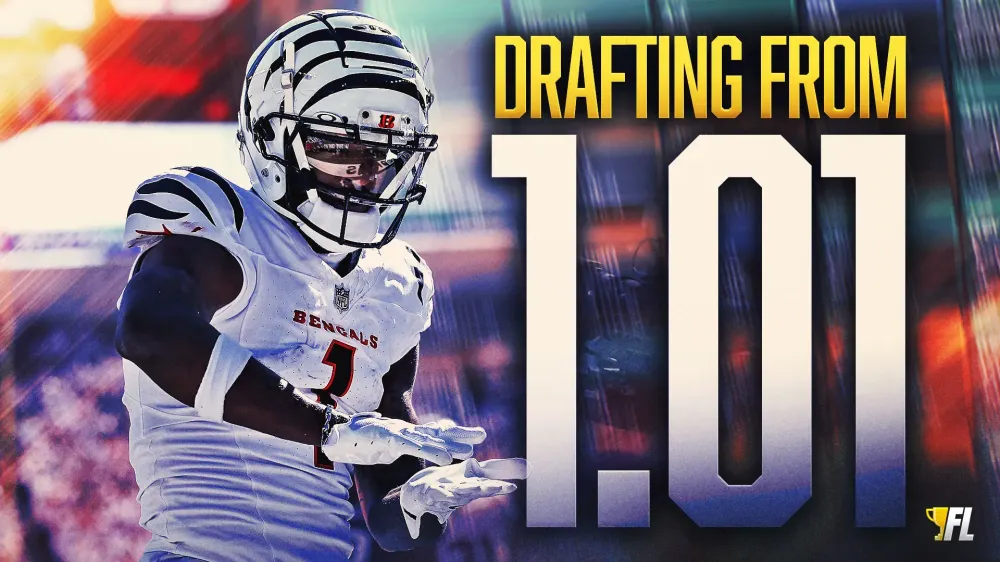
Drafting From 1.01 in 2025 Fantasy Football: Ja'Marr Chase or Bust?
Chris Allen breaks down the nuances that come alongside having the 1.01 in fantasy football drafts and answers the burning question—is it Ja'Marr Chase or bust in 2025?
I must be getting old. Or maybe the draft community is getting sharper. Both are probably true. Anyway, drafting first overall isn’t as glamorous as I remember.
Getting the 1.01 used to be like Charlie discovering a golden ticket in a Wonka bar. I won. I didn’t have a player on my roster, but I could already see my squad in the playoffs. My leaguemates would hate playing against me. All because of my enviable draft position.
And it is. Don’t get it twisted. Leading off your draft has its advantages. But you can’t go on autodraft. The other 11 people are out to ruin your fun. So, let’s pull together a strategy for maintaining an edge from the one spot.
For all 12 of my pick-specific draft strategy pieces, see below:
The 1.01 Debate In Fantasy Football
Having the 1.01 is all fun and games until you enter the lobby, right?
The illusion of having any player at your disposal fades away. There’s only one “right” answer. A poor choice will ruin everything. Luckily, I’ve walked through how to weigh our options for this pick before. This year’s Top 3 aren’t too different.
- Ja’Marr Chase
- Saquon Barkley
- Bijan Robinson
Last season, I walked through how Christian McCaffrey’s usage as both a runner and receiver gave him a clear advantage over the other players vying for the first pick. Now, let’s consider a WR who put together a historic campaign in ’24.
At 127 receptions, 1708 yards, and 17 TDs, Ja’Marr Chase was a phenom both in real and fantasy football. He had more catches than the number of targets Terry McLaurin earned (117). Chase was 15 yards shy of matching the yardage total of the entire Patriots’ WR corps (1723). But, hype aside, there are two things worth reviewing before snap-clicking his name.
Can he repeat his 2024 performance?
First, if I could, I wouldn’t be writing about it (until after placing a sizable wager on it!). Second, let’s reframe the question.
Production comes from opportunity. And Chase got quite a few last season. However, his path to increased volume didn’t become any easier. Tee Higgins is still there (thankfully). Cincinnati kept ancillary options like Mike Gesicki around. Last year’s WR1 would need to have the intrinsic traits to maintain similar output from the year before. Fortunately, his underlying metrics suggest this is possible.
- 2021: 12.9 (aDOT), 7.9 (YAC per Reception), 18.4% (Slot Rate), 2.49 (YPRR)
- 2022: 9.1, 4.8, 23.7%, 2.03
- 2023: 8.9, 5.5, 23.5%, 2.02
- 2024: 8.7, 6.2, 33.6%, 2.42
Giving Chase a larger role in the slot has paid dividends for Cincinnati’s passing game. Not only do the short-area targets create higher-percentage throws for Joe Burrow, but they also get Chase in space to operate after the catch. His yards after the catch totals returned to his rookie season pace after a two-year decline. So, yes, even if Chase’s share of the looks (slightly) comes down, where he catches the ball and his ability to weave around defenders should keep him in contention for the WR1 rank by season’s end.
Is he a better option than the RBs?
Well, that’s partially a matter of personal preference.
If strategies like “Anchor-RB”, “Heavy-RB”, or even a balanced approach fit your ethos, I won’t knock it. I’ll be singing the praises of Barkley and Robinson in the next two articles about the 1.02 and 1.03. But again, let’s reframe the question. I’ll use our Draft Champion tool to help.

After a few clicks, I can simulate what could happen in a 12-team league with our rankings and up-to-date ADP. Things might vary in your league, but this isn’t far off from reality. Regardless, the Draft Assistant can tell us what to expect at WR should we pass on Chase at the 1.01.
Let’s have a qualitative discussion about the concept of opportunity cost. So, instead of Chase, you could tie yourself to one (or two!) 30-plus-year-old receivers. Admittedly, I mention their age as a negative while conveniently leaving out their projected workloads. At the same time, Bucky Irving, Kyren Williams, and James Cook are still available at RB. While none offer the same upside as the primary rushers in Atlanta or Philadelphia, their floor for touches on a per-week basis isn’t vastly different. Or, put another way, the drop-off in talent isn’t as steep when compared to the WRs. But let’s try a few builds.
- Multiverse 1: Ja’Marr Chase
- Multiverse 2: Bijan Robinson
- Multiverse 3: Saquon Barkley
If you’re like me, you’ve looked at the post-draft board with (a tinge of) regret. There’s always one decision you wish you could take back. So, while the process is more important, I’ll build three different teams to highlight how each strategy can work.
The Rest of the Early Rounds
Like I said before, having the 1.01 isn’t about just one pick. You’ve got (the rest of) an entire roster to build! And the early rounds are the best spot to build a juggernaut. Accordingly, I have two general objectives to guide my next five selections.
- Grab one QB or TE.
- Build starter power at the core positions.
The first goal initially seems simple. However, fear of missing out can then take over. I’ll use the simulator to explain.

A Chase-Hill-Williams open is as safe a start as they come. But look at the QBs and TEs I lost in the process. All of the elite options are gone!
The common response? Panic. Get one of each. Immediately.
Well, let’s take a step back first. Focusing on the onesies early is a solid approach. While Best Ball doesn’t have the same playoff structure, we can use some of the roster construction data to see how beneficial targeting QB or TE early can be.
- (Playoff Teams) Drafted 1 QB early: 24.0%
- Drafted 1 TE Early: 29.1%
- Drafted 1 QB and 1 TE Early: 22.9%
Of course, in-season dynamics can make any construction work. But again, having (loose) guardrails in place can keep us on the right path. On the flip side, it’d be easy to knock out both positions at the turn. Afterward, the spotlight would be on RBs and WRs. However, we’d have to lower expectations for our final roster.

There’s no secret to the fantasy market. Productive players are worth more. Simultaneously, we need to start more RBs and WRs than QBs or TEs. The resulting dilemma forces a decision point. Like the above draft board shows, I’ve got a few paths to go down.
- Draft another RB (e.g., James Conner, RJ Harvey)
- Boost my WR group (DJ Moore is there)
- Add a QB or TE (Patrick Mahomes or T.J. Hockenson still available)
Here’s where rankings and tiers can be useful. Both Mahomes and Hockenson reside in Tier 2 of their respective positions. I’m willing to bet I could get another second-tier TE at the 6/7 turn. Meanwhile, Baker Mayfield is the only other passer available in the group with Mahomes. So, I took the Chiefs’ QB1 and pushed TE.

Besides, it’s a mock draft.
Am I happy with Kyren Williams and Tony Pollard as my starting RBs? Check back with me after Week 1. But three WR1s and a high-end QB are solid building blocks. I feel similarly about the other teams.
I leaned into WR on Team 2 to boost my floor and ceiling with Higgins, Hill, and Harrison (believe me, the alliteration was not a factor). With Robinson and Pacheco as “workhorse” RBs, I’d only need depth. Team 3 just needs a TE and options on my bench. Sure, some of the names might not inspire as much confidence as I’m conveying. However, by viewing each roster through the lens of positional value, each has a chance to become a contender as we head into the middle rounds.
Mid-Round Approach
Similar to the early phase of the draft, I have objectives for Rounds 6 to 12.
- Finish the onesies.
- Address depth and bench slots for the core positions.
To be clear, the order doesn’t denote priority. For example, I mentioned I wanted to grab Andrews for Team 1 after taking Mahomes at the 5.01. It didn’t make the Ravens’ TE1A (?) an auto-click. If another high-value option at RB or WR had been available, I’d adjust. However, the board fell that my decision was easy.

Now, to be fair, I did have something of a conundrum at the 7.01 for Team 1.

Adding Rome Odunze to the WR room of Chase-Hill-Wilson would’ve bolstered my floor at the very least. In addition, I could’ve shifted TE to the backend of the mid-rounds with targets like Tyler Warren available. Either way, my roster had pieces that would be competitive from the start of the season and throughout. The same goes for the other two squads.
Team 2 hinges on Caleb Williams’ development, and Team 3 may need to cycle through TEs to stay afloat. But no roster is perfect. It’s why we work through mocks to see what’s in the realm of the possible. In either case, by understanding how to leverage the first-overall spot, we can continue to stay ahead of our leaguemates during the draft and the regular season.

Premium
Go FantasyLife+
Your league is unique. Your advice should be too. Get personalized tools, rankings, and projections tailored to your fantasy football league settings.